Water additives can play a real supporting role in your pet’s oral health, but they work best as one part of a broader home-care routine, not a standalone fix. These products are designed to reduce the bacteria that drive plaque formation, and some carry a Veterinary Oral Health Council (VOHC) seal confirming they meet accepted standards for reducing plaque or tartar. The evidence on water additives and other home care products is genuinely interesting and more nuanced than the marketing suggests: combined with even modest mechanical care (weekly brushing or a daily dental chew), they substantially improve periodontal outcomes. That combination effect is the real story, and it shapes how a home-care routine should actually be built.
At North Bay Veterinary Dentistry in Petaluma, we specialize exclusively in dental and oral health care for dogs and cats, which means we follow the literature on home care closely and translate it into practical guidance every day. Our periodontic services include the kind of targeted care that puts home maintenance in its proper context. Whether you are building a prevention routine for a young pet or managing active gum disease, we are happy to help you put together a home-care plan that fits. Reach out to schedule a consultation and we will walk you through what actually makes a difference.
Dental Home Care at a Glance
- Brushing is the gold standard: nothing else replaces the mechanical disruption of plaque that a brush provides, and the data confirms it works at multiple frequencies.
- Combinations outperform single tools: the strongest evidence supports layering mechanical and chemical care together.
- Water additives supplement, modestly: they offer meaningful benefit mostly in combination with mechanical care.
- Home care does not replace cleanings: professional cleanings under anesthesia address hardened tartar and disease below the gumline.
Why Does Dental Home Care Matter?
Dental home care matters because plaque, a bacterial film, begins forming on teeth within hours of cleaning and mineralizes into tartar within days, and tartar can only be removed mechanically. As plaque and tartar accumulate, gingivitis develops, then periodontal disease, then tooth loss and infection that can spread to the heart, kidneys, and liver through the bloodstream.
The progression is predictable but slow at first, and daily or near-daily home care meaningfully slows it. Without home care, the timeline accelerates and the disease that develops is harder to reverse. Professional dental cleanings under anesthesia remain essential periodically, but the work between cleanings determines how often they are needed and how invasive each one becomes.
What Does the Research Say About Brushing?
Toothbrushing is the gold standard because it directly disrupts the bacterial biofilm before it hardens, something no chemical treatment, enzyme, or dental diet matches. The evidence on this is consistent and growing.
A 2021 study compared four cleaning tools used daily for five weeks in 21 beagles: a manual toothbrush, an ultrasonic toothbrush, a nylon glove, and a microfiber finger cloth. All four methods produced statistically significant improvements in total oral health, and in both gingival health and plaque reduction individually. Calculus did not significantly decrease across the group as a whole over the five-week window, which is expected- nothing really removes hardened tartar except a professional cleaning. Two findings from this study matter for practical home care: first, the simple tools (a finger cloth or nylon glove) worked nearly as well as toothbrushes for plaque and gingivitis, which gives families a meaningful option when a brush is not tolerated; and second, the dogs’ stress, fear, and anxiety scores measurably decreased over the five weeks of daily cleaning, meaning the pets adapted. The takeaway is that the “my dog will never tolerate brushing” objection is often the introduction problem rather than a fixed reality.
A larger 2024 study reinforced that brushing every other day with toothpaste significantly reduced dental deposits compared with an untreated control group over a 16-week period. Notably, weekly brushing alone did not produce significant deposit reduction in this study, consistent with earlier work. That detail matters: the data does not support the idea that occasional brushing is “good enough.” Daily or every-other-day brushing is what the evidence actually backs.
Getting Started With Brushing
The introduction matters, because most pets who hate brushing were not introduced gradually, and the negative association makes future attempts harder. A progressive approach using cooperative care techniques:
- Muzzle touching. Touch your pet’s muzzle, give a treat, and stop, building a positive association with face handling.
- Lip lifting. Lift the lip briefly, treat, and stop, repeating over several days.
- Finger introduction. Run a finger along teeth and gums, treat, and stop, using pet-safe enzymatic toothpaste on the finger to introduce the taste.
- Finger brush or textile. Move to a rubber finger brush, nylon glove, or microfiber cloth, used briefly with toothpaste.
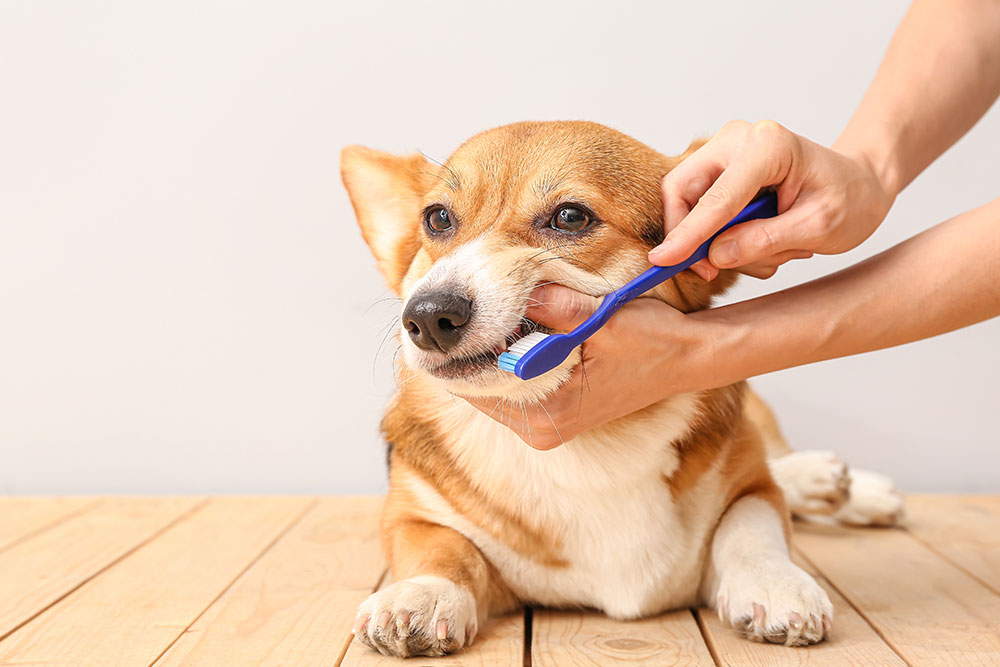
- Full brush. Use a small pet toothbrush along the outer surfaces of teeth, since the inner surfaces are less critical because the tongue keeps those cleaner.
Use only pet-safe enzymatic or pet-formulated toothpaste, never human toothpaste, which contains ingredients like xylitol that are toxic to pets. Technique varies a little by species:
- Dogs: approach from the side, lift the lip, and brush in small circular motions along the outer surfaces, focusing on the upper canines and the large carnassial molars where tartar accumulates fastest.
- Cats: use a smaller brush or finger brush, and start with shorter sessions; cats often tolerate brushing better than expected when introduced patiently.
Brush for about 30 seconds total, working through quadrants on the outer surfaces, and keep sessions short and positive. Common mistakes that create negative associations include forcing pets through long sessions, using human products that taste wrong, brushing too aggressively, or stopping abruptly when the pet resists rather than backing off and rebuilding.
How Well Do Dental Gels, Sprays, and Water Additives Actually Work?
For pets who will not tolerate brushing or dental wipes, dental gels, sprays, and water additives offer alternative ways to deliver active ingredients to teeth and gums using enzymes that break down plaque chemically. They are less effective than brushing for deposit reduction, but they are real interventions, not placebos.
The 2024 study mentioned previously tested six home-care protocols against an untreated control. In this study, water additives used alone, without any mechanical care, did not significantly reduce dental deposits except when combined with some sort of mechanical care, like brushing or dental chews. A water additive plus a dental chew or brushing had better results than just the chew or brushing alone.
The mechanism the authors propose is that mechanical action breaks up the biofilm and exposes the underlying tissue to the antimicrobial in the additive, where it can actually work on the gingiva. Water additive alone faces a thick biofilm it cannot effectively penetrate; mechanical care alone removes the deposit but does not deliver chemical support to the gum tissue; combined, they cover both sides of the problem.
Another study in 2023 showed that water additives used daily for thirty days right after a dental cleaning showed significantly less plaque, calculus, and gingival bleeding compared to dogs who had a cleaning but no care afterward. This makes sense- that thick biofilm was removed during the cleaning, giving the water additive a chance to actually work.
Water additives, sprays, and gels are not a substitute for any kind of mechanical care. But for families who can only brush weekly, or who rely primarily on dental chews, adding a daily water additive turns a marginal routine into an evidence-backed one. Look for the VOHC seal, which confirms the product has been tested against established standards rather than just marketed against them.
Do Dental Diets Help?
Dental diets work through both ingredients and kibble shape: some include calcium-chelating agents that reduce tartar formation, and some use large, fibrous kibble that requires more chewing and provides mechanical cleaning as it breaks against tooth surfaces. The evidence supports the mechanical-cleaning kibble approach particularly well in cats.
A study compared four feeding groups over six months after professional cleaning: small kibbles with mechanical cleaning qualities, small kibbles without those qualities (plus owners brushing), large kibbles with mechanical cleaning qualities, and small kibbles without mechanical qualities and no brushing. The cats fed large kibbles with mechanical cleaning qualities had significantly less gingivitis and tartar than the other groups, including the brushing group. The conclusion is not that diet replaces brushing, but that for cats specifically, who often refuse brushing entirely, a properly engineered dental diet is a serious intervention rather than a marketing claim.
Dental diets extend the time between professional cleanings rather than replacing them, and for pets at higher risk from breed, age, or prior periodontal disease, incorporating one alongside other home care can meaningfully slow plaque accumulation.
Are Dental Chews Worth Using?
Dental chews have one of the stronger evidence bases among home-care options. A 2005 study tested a daily dental chew against a control group fed an identical diet without the chews. Dogs receiving the daily chew had significantly less gingivitis, significantly less plaque, and significantly less calculus after four weeks. The 2024 study mentioned before also independently confirmed that a daily dental chew alone significantly reduced dental deposits compared with no treatment. Two studies, two cohorts, the same finding: a well-designed daily chew measurably moves all three relevant outcomes.
The catch is that not every chew sold as “dental” actually performs, which is why the Veterinary Oral Health Council seal matters. The VOHC reviews products against specific standards, and chews with the seal are the ones that have been tested rather than just labeled.
Safety considerations matter as much as efficacy, since the fractured tooth from a too-hard chew is one of the most common dental injuries we treat. To avoid that:
- Use the thumbnail test: if you cannot dent it with your thumbnail, it is too hard for your dog’s teeth.
- Avoid known-risky chews: dangerous chew items include real bones, antlers, hooves, hard nylon products, and large pieces of hard plastic.
- Match size and texture to the individual pet, since a large dog needs different products than a small one.
- Supervise to monitor for choking hazards or digestive upset.
How Do You Choose Effective Dental Products?
The simplest filter is the Veterinary Oral Health Council seal, since the VOHC is an independent organization that evaluates dental products for evidence-based effectiveness at reducing plaque or tartar, and the seal represents verification rather than a marketing claim. The VOHC evaluates dental chews and treats, water additives, dental diets, wipes and gels, and toothpaste. The table below puts the main home-care tools in perspective:
| Home-care tool | Effectiveness | Notes |
| Toothbrushing (daily or every other day) | Highest | Mechanical plaque removal, evidence-backed at this frequency |
| Textile cleaning (wipes, nylon, microfiber) | Moderate to high | Real effect on plaque and gingivitis; useful when brushes are not tolerated |
| Water additives (alone) | Moderate to high in combination | Work well after cleanings or in combination with brushing, wipes, and chews |
| Dental diets (mechanical cleaning kibble) | Moderate to high | Particularly strong evidence in cats |
| VOHC dental chews | High | Statistically significant reductions in gingivitis, plaque, and calculus |
The combination effects shown in the studies have a practical implication: a routine that pairs mechanical care with chemical support outperforms any single intervention. The exact products matter less than the combination structure. Mechanical care addresses the biofilm; chemical care addresses the gum tissue; together they cover the full clinical problem.
What Can’t Home Care Replace?
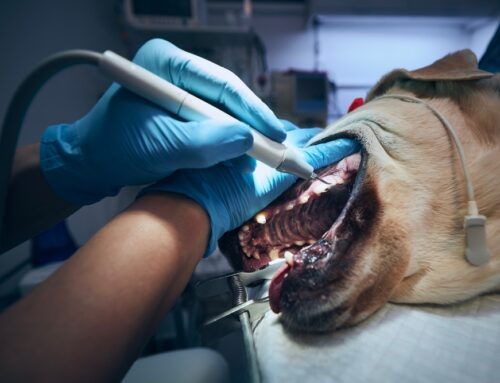
Even the most diligent home care cannot remove tartar that has already hardened on teeth, and it cannot address disease below the gumline where most periodontal disease actually happens. Professional cleanings under anesthesia remain essential for:
- Thorough scaling of the entire tooth, including below the gumline where you cannot see
- Polishing the tooth surface to slow new plaque formation
- Full-mouth dental radiographs to identify problems invisible above the gumline
- Probing and charting of gum pocket depths to assess disease stage
- Treatment of identified problems, including extractions, root planing, and other targeted interventions
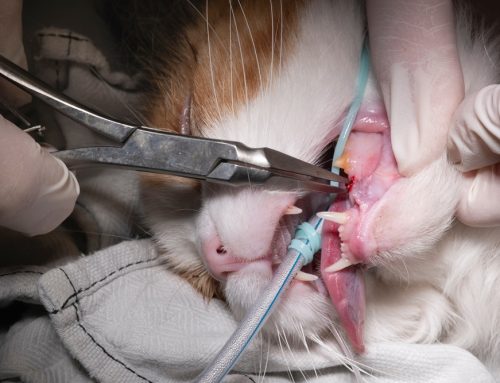
Anesthesia-free dental risks are significant, since without anesthesia only the visible parts of teeth can be scraped, the area below the gumline cannot be cleaned, dental X-rays cannot be taken, and the procedure is stressful for the pet, so the cosmetic result may look improved while the underlying disease progresses unchecked. Our anesthesia protocols are tailored to each patient with the safety standards that anesthetized dentistry requires, and as a specialty practice, every dental procedure we perform happens under anesthesia with full monitoring.
How Do You Build a Sustainable Routine?
A sustainable routine is one that actually happens, so the practical strategies focus on consistency:
- Pair it with daily routines, like brushing at the same time as feeding or evening walks.
- Start slowly, building the brushing habit over weeks rather than days.
- Use combinations from the start, since adding a daily water additive to even weekly brushing produces evidence-backed improvement in periodontal health.
- Have back-up plans, like a VOHC-approved chew or a dental wipe on days the brushing does not happen.
- Involve the whole family, with different members handling different parts.
- Adjust as needed, since what works for a young dog may need modification with age.
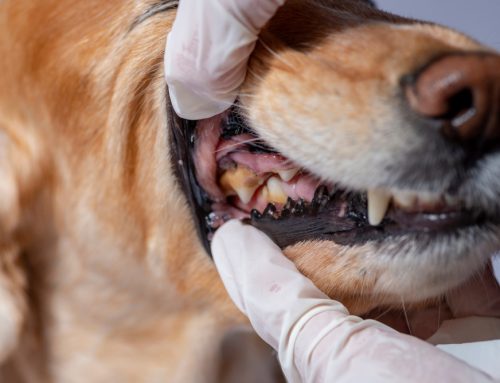
Signs that home care is working include less visible plaque, better breath, and healthy pink gums, while signs that professional intervention is needed include visible tartar, red or swollen gums, bad breath, dropping food, pawing at the face, or any discolored, broken, or loose tooth.
Frequently Asked Questions About Pet Dental Home Care
Are Water Additives Safe for Cats?
For most cats, yes, when used as directed. The exceptions are cats with kidney disease, bladder issues, or a known sensitivity to the additive’s ingredients. Cats are also pickier about water taste than dogs, so palatability is a bigger concern, and you should introduce gradually and watch for any reduction in water intake. If you have a cat with known urinary or kidney issues, check with us first.
How Often Should I Brush My Pet’s Teeth?
Daily is ideal, every other day produces evidence-backed reductions in dental deposits, and weekly brushing combined with a daily water additive is the minimum protocol shown in the literature to improve periodontal health. Weekly brushing on its own does not produce significant benefit.
My Pet Hates Having Anything in Their Mouth. What Can I Do?
Start much smaller than feels productive, just touching the muzzle and giving a treat for several days, then briefly lifting a lip, then a finger with a tiny amount of pet toothpaste. Give dental chews or use a dental diet when brushing isn’t possible.
How Often Does My Pet Need a Professional Dental Cleaning?
Most adult dogs and cats benefit from annual professional cleanings. Pets with active periodontal disease, broken teeth, or other issues may need more frequent intervention, while pets with excellent home care and good genetics may go longer. We assess this individually during evaluations.
Building a Routine That Keeps Teeth Healthy
Effective home care, layered thoughtfully and combined with regular professional cleanings, produces the best long-term outcomes for pet dental health. No single product or routine is sufficient, and the consistent layering of multiple tools- mechanical and chemical, daily and weekly- is what the evidence supports.
If you want help putting together a home-care plan that fits your pet, or if you are managing active dental disease that needs specialty attention, contact us for a consultation.